Monday, February 17, 2025

Group Meeting #1

    Hey Cambridge! Before the long weekend, we had a class where we were put into groups of four and offered/gave advice on each other's movie opening ideas. We went one by one and spoke about what we have so far, ideas we're interested in, and then the other three people gave their tips. I'll touch base on my classmate's ideas, but mainly what I came in with and walked out with.


Pedro:

    A man recovering from witnessing paranormal activities (maybe in the forest while hunting) but nobody believes him and he can't let go of it. The opening scene would either be the paranormal activity itself or a therapist appointment about it.

Oona:

    A young adult woman gymnast has a bad injury and has to recover before a big event or competition. Takes unapproved medicine that is detrimental to her brain but is at least healing her injury. The opening scene would most likely be the injury taking place because she works at a gym and has access to all the gymnastics equipment.

Tiziana:

    She doesn't have a very clear idea of what she wants to do for the film itself but has an idea for the opening. A young adult is shopping for groceries and then driving home and baking while listening to a radio station when it suddenly gets cut off to announce a murder in her town. The main character would look concerned, surprised, and urged for something but the purpose isn't known yet.

Sergio:

    A medical school student is diagnosed with a rare undocumented muscle disease and he's got to get into the gym while he's in school and at the same time trying to find a cure to his own disease. He's a very square and organized person while still slowly going into madness from how much he's taking on. The opening would be him in the gym and studying/finding a cure with a voiceover of what's going on in a journal style. His seems to be the most figured and planned out.


What I Walked In With

Notecard with my initial movie opening plan

    When I walked in, I didn't have the clearest idea of what story I wanted my movie opening to tell, but I had more of a clue about who I wanted my main character to be. I had an idea that she would either look like the perfect little princess but had a "teenage dirtbag" attitude OR she looked poor and rough but was the sweetest person and just wanted to make her way up in the world. If she ended up being the first option,  she would be inspired by the 2020 take on Jane Austen's Emma when it comes to costume and hair design. The music in the background would be completely the opposite though so the audience knows she's something other than what she seems. If she seemed like she was having a rough experience or on the less wealthy side, there would be beautiful classical music playing. This aspect would allude to the fact that she's doing something much different with her life than what she wishes to be. The mystery would be developed by showing small, quick details that make the viewers think "Huh, that doesn't really make sense from what we know of her. What else is going on?" Maybe it would be some kind of money stash or blood splatter on her things; I wasn't too sure. 


Advice Given To Me

    I told the group that I was also interested in pursuing a psychological drama plot with the trauma convention which I spoke about in one of my past blogs and this was the advice and/or ideas given to me.
  • "Instead of the traumatic event happening at the beginning of the movie, it should happen before the start."
  • "To give it a more psychological feeling, maybe the viewer doesn't know what happened until the very end."
  • "What if the main character doesn't know until the very end either?"
    THAT idea totally hooked me, so I asked "Ooh! What if the traumatic event happens, but the main character gets drugged, or lobotomized, or something to forget the event because she's of high class and couldn't be seen going insane from it."
  • "Yeah, like how in The Truman Show he slowly pieces together odd parts of his life until he figures out what's actually going on."
  • "You should watch Shutter Island, it's on the topic of lobotomies."
  • "Just how in the beginning of Eternal Sunshine of the Spotless Mind, Joel has impulsive actions and finds random things he has no recollection of."
  • "I know you said you wanted minimal dialogue, but what about a voice-over? It would help with the whole unreliable narrator thing."
  • "Do you know what you want the actual traumatic event to be?"
    To this, I replied that it could possibly be witnessing a loved one suicide or die in their arms. Something including a person close to them suddenly gone.
  • "I feel like aimlessly wandering or running in a field would fit the cluelessness."
"Yeah! What somebody hung themselves and she's running in the field where it happened and stumbles across a strangely familiar tree, but doesn't really know why."
  • "That sounds really good, there could even be different close-ups and eye matches to small things in the grass to show that she's very attentive and innocent since the memory wipe."

What I Walked Out With

    After these insanely helpful people gave me much-appreciated ideas, I have a way more precise image in my head for the opening. I want my movie to begin with a girl picking flowers, the chirping of birds, bright skies, and a beautiful field. Then, she pulls out a diary and begins writing as the voice-over begins of her talking about herself and how mundane her life is at home. She gets into talking about how she's never had anybody her age close to her and nobody tells her anything. At the same time, she's shown 'frolicking about' on the field, looking at tiny plants and bugs, and just rolling around aimlessly. At the same time, beautiful classical music is playing. That is until her mother calls her to come back inside and she starts walking back looking unamused by the command. As she's going back, she walks past a tree with half of a noose tied to it and the title is shown with a dark, gothic font. It pans around to her eyes showing a puzzled and concerned face, and when her mother calls her again, she books it.


Conclusion

    Overall, I have a perfect image of what I want my opening to look like and am extremely enthusiastic for the production to begin. See you tomorrow, Cambridge!

Sunday, February 16, 2025

Going Back to the Regency Era

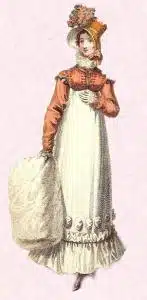
     A crucial aspect of any period piece is costume design. I need to analyze color and the costume itself within my main character's costume design. 


    Tracking fashion trends of 1795-1825, I'll review the history, styles, and trends.


History

    During the French Revolution, the textile market plummeted dramatically. To prevent it from further plunging, Emperor Napoleon Bonaparte banned the import of foreign textiles, brought back older Valenciennes lace dresses, and mass-produced local textiles as much as possible. To maintain the market on the rise, Napoleon stated that women must not wear the same dress on more than one occasion when courting. He also had fireplaces blocked off at the popular Tuileries Garden so that ladies were forced to layer up on clothing when going out. Men weren't left out of the equation either since it became policy for male military officials to wear exclusively white satin breeches when at a formal event. These practices might've all seemed extreme, but Bonaparte was simply following past tactics of boosting France's economy through clothing and fashion. Additionally, Empress Josephine was a huge image in fashion in France at the time, and she aided in the influence of purchasing increasingly more fabrics. 
"[Empress] Josephine in full regalia gold" (Thomas 2009)

Styles

    In the late 18th century, nearing the early 1800s, the Empire Style became one of the more well-established looks. Women were adorned with full, flowy skirts and waistlines sitting directly under the chest. Necklines went from square to round to V-shaped with age and being hardly able to move their arms from their tight puffed short sleeves was considered the daintiest in a girl. Also, EVERYTHING was laced. Everything. Obviously, that directly stems from the production of the Valenciennes bobbin lace, but still! There were three mainly used fabrics that each played to the girl's social status and usage which were muslin, white lawn, or batiste. Muslin seemed to be the most affordable and easy to take care of while still having an array of embroidery designs and pristine quality, showing signs of wealth. White was the most expensive color to wear since it gets dirty more easily than every other color. Because of this, they were most often worn in the evening and pastels during the day.


       Square neckline        V-shaped neckline     Round neckline      

Trends

    During the English Regency Era and the French Regency Era, different trends in clothing came in and out of fashion portraying different social groups and displaying different levels of wealth. In 1815, French skirts started much higher than English ones, and English skirts were "wider, more A-line, padded, and decorated" (Thomas 2009). Waistline trends also fluctuated between 1815 and 1825, reaching their peak height in 1816 and lowering ever since. Anglomania, defined as excessive admiration of English customs, swept France when lowering the waist and adding fillers like horsehair to widen the shoulders and skirt, giving ladies a more hourglass-like silhouette. At this time, the waist was finally at its most natural point. The Spencer is a short, tight, long-sleeved accessory that gained popularity in 1817. There are a few different versions that all essentially work as a cute, layer-able jacket whether extremely short or reaching down to the waist. It seems as though even then, fashion trends were quick and the ladies of the past were influenced just as easily.


    Regency Spencer Styles                           Lowest vs Highest waistlines


Weston Thomas, P. (2009, February 24). Regency Fashion History 1800-1825 | Beautiful Pictures Empire Line Dresses. Fashion-Era. https://fashion-era.com/fashion-history/regency/regency-fashion

Tuesday, February 11, 2025

Interpreting the Schedule

    Obvious steps towards the final product:

  1. Research
  2. Planning
  3. Production
  4. Editing
  5. Revision
  6. CCR
    The way I'd break these steps down makes more time than usual for finding costumes and editing. This is because I need to research and find out how to accurately dress my character and edit the whimsical, clueless, innocent moment the m.c. is having.

Week one (2/9 - 2/15)

  • Research
    • Costume design
    • Music
  • Begin setting up
    • Storyboard
    • Find actress or somebody to film

Week two (2/16 - 2/22)

  • End setting up
    • Thrift/purchase costume
    • Find park to film in
    • Schedule filming
    • Practice hair design
    • Script
    • Find music
City Parks | City of Weston, FL. (2024). Westonfl.org. https://www.westonfl.org/government/parks-and-recreation/city-parks


Week three (2/23 - 3/1)

  • Production
    • Filming
    • Begin (and possibly end) foley
    • Begin voice over if decided on
  • Editing
    • View next week plans

Week four (3/2 - 3/8) 

  • Editing
    • Line up shots to music cues
    • Line up foley 
    • Line up voice over if decided on
    • Visual editing (adjust lighting)


Week five (3/9 - 3/15)

  • Revision
    • Double-triple-check timing, editing gaps, foley overlaps, and length
    • Plan a mock analysis on my own opening
    • Revise missing items

Week six (3/16 - 3/22)

  • CCR
    • Plan a smaller research chart on my own opening
    • Write reflection
    • Compare to examples to edit and improve

Week seven (3/23 - 3/29)

  • Free time in case there are challenges or delays along the way

Saturday, February 8, 2025

Looking for My Ideal Credit Sequence

     Though in my last blog I mentioned I'd wait to research stylistic and mise-en-scene choices regarding the period I want my opening to take place in, I now realize why waiting so long is a bad idea. Because of this, I will focus this post on the period drama aspect of my opening. My idea for my opening is to use the tragedy convention of psychological dramas, meaning that a tragic event took place before the movie commences and the film consists of the "aftermath" or breaking down of the main character's emotional state. I also liked the idea of an unreliable narrator, so perhaps the trauma can be the stem of their unreliability. Still, I want to keep the contrast aspect of perfect on the outside and odd on the inside. For this reason, I want the credits to develop a pristine, Regency Era type of setting and mood.


EMMA (1996)

    In the 1996 film EMMA, the opening credit sequence features the perfect extreme long shot to display the period they're portraying in the movie. The horse-driven carriage and the regal font for the title pair together flawlessly. The carriage moving somewhere as the title is being shown implies that there's more to come and doesn't make putting it at the end of the opening feel conclusional. Instead, it alludes to their next stop and adds a sense of continuation even though the opening itself is ending. The font difference between the original author's name and the title is subtle but makes such a difference. The smaller cursive font makes the all-caps bold title have an even bigger impact by comparison. I like how it develops a familiarity with the protagonist from the beginning.


Bridgerton (2020)

    Bridgerton is one of the most popular period dramas currently, so I couldn't NOT mention it. One thing I noticed while watching the credits is the placement of the names. Placement and speed are important factors when displaying credits because all the people who put hard work into films should be properly recognized for it; it would be pretty distasteful for them not to be. For this reason, it should be easy to spot names even when more things are going on in the background. This opening does an astounding job at this since they always focus the names around whatever is going on the screen. For example, when the vines are climbing up the tree, the name of an actor is right there next to them. Though the font in this opening doesn't seem to belong to the Regency Era as much as my last example, it illustrates the more modern approach this show has.


Little Women (1994)

    The beautiful graphics in the title sequence of the 1994 adaptation of Little Women are a perfect instance of the graceful design of women in the 1860s. The sharp lettering of the words contrasts heavily with the flowy swirls. I believe this has a deeper meaning than it might seem. The sharp versus the soft illustrates the range of women and how broad the range of women's persona in this specific film will be developed. I'm quite interested in illustrations and art like this that can be interpreted in many different ways and possibly something I'll want to include in my title.


Friday, February 7, 2025

Film Openings Genre Inspo

     Though I want to create a film opening that isn't only a psychological drama but also a period piece, I'm going to dedicate the mood board to doing research for the period elements and the film openings research for psychological dramas. The genre has so many different interpretations, and I wish to find and be inspired by movie openings focusing on unreliable narrators.

Eternal Sunshine of the Spotless Mind (2004)
    
    Just so happening to be my personal favorite movie, Eternal Sunshine of the Spotless Mind is a psychological drama having to do with two lovers who erased each other from their memories. The movie sort of moves backward, so the opening is them meeting again as complete strangers, and the rest of the movie is the story of what happened and how. In the opening, Joel is an unreliable narrator because he makes decisions without knowing why, and lots of aspects like his car being broken, pages ripped out of his journal, and impulsively going to an empty beach show that there are factors behind his actions that the viewers haven't been exposed to yet. In my movie opening, I want to incorporate random and unexpected decisions made by my main character that wouldn't sort of make sense with the way she seems to be. Initially, I thought I didn't want much dialogue in my opening because I wanted it to be guided by music, but I'm really attracted to the idea of a voiceover where my character doesn't really know what's going on either. The lack of knowledge might be caused by a sickness or a sort of drug that caused her to forget recent events. I also noticed the entire movie opening is shot with a handheld camera, making it almost seem like he is being documented in his world or the audience watching him in secret. I noticed this when he was running to the train impulsively. It was a high-angle shot from above the bridge while he ran below and then a shot from downstairs while he was running on the bridge. At every point, the camera seemed hidden. It reminds me of the way the movie Project X was filmed; one of the characters was filming the entire event as if he was making a documentary on the entire party. It gives a sort of subtle uneasiness, which I really liked. Apologies if I wrote too much; I don't know if you can tell how much I love this movie.

Pearl (2022)

    This opening is the perfect example of what I had in mind when describing the girl who's not who she seems to be. In this opening, Pearl is first portrayed as living on a perfect little farm, dressing in her beautiful dresses and living an ideal life until her mom tells her to feed the animals and pops her bubble. After that, she becomes this innocent picture again performing for her farm animals and pretending to be a star until a goose sneaks into the farm, and she kills it and feeds it to an alligator. One would never expect such a hopeful, beautiful, innocent-looking girl to be so deathly and aggressive. It is similar to the way the movie Emma. does contrast. In Emma., she seems to have a perfect, easy life, yet the editing and dialogue portray a gloomy, moody tone, like how the mise-en-scene in Pearl is bright and happy, the music is beautiful, and she looks adorable while she's slaughtering an animal with a pitchfork. I noticed a theme in the title of just their names, which is similar to the presentation I want for my character, so the title being her name could definitely be an option.

Requiem for a Dream (2000)

    Requiem for a Dream's opening is a really great example of what I was looking for when it comes to music. I had an idea of a perfectly normal scene with dramatic and mysterious music in the background to serve the purpose of hinting at something the audience isn't being told. I've never seen this movie, but if I were to watch this movie opening without music, I'd think it's something along the lines of two friends going somewhere to sell this TV. However, the low and dramatic music sets a foreboding tone, implying that there's more to what's being shown. Despite the kind old ladies wearing bright colors and the setting seeming like a hot summer day, the music provokes suspicion in the viewer. On some occasions, dialogue can simply not compare to the effect music has on a visual scene, which is why I'm looking to focus on the music instead of the words.


Wednesday, February 5, 2025

Investigating Genres

    Genre is the most-base level step towards planning a production. Whether Coming-of-Age or Science Fiction, extensive research and a countless number of decisions need to be made until the final product is achieved. I've chosen two genres that interest me in using in collaboration for my movie opening. The two are period dramas and psychological dramas. I want my movie opening to introduce a puzzling dramatic film from the early 19th century with a deeper meaning that everyone can relate to. Obviously, I'm not producing an entire movie to show this off, but a girl needs an imagination!


PERIOD DRAMAS
Les Misérables (2012)

    Period pieces are films that strongly hint or revolve around the time period they take place in. Usually staged in late 18th century to early 20th century, social standards or norms of the era are often the spine of these stories. The mise-en-scene in these openings are mostly for the purpose of developing setting and the time period. For instance, sound should be period classical, clothing should be appropriate to time period and financial level of character, lighting should not be electric due to the lack of electricity, and props should replace all electrical and/or digital items.

    What makes a period piece stand out is often its accuracy. Viewers want to feel like they're truly watching drama and struggles of people from past centuries because there's hardly real documented scandal from that era. It doesn't make a difference how entertaining and well-written the film is if it doesn't make the audience convinced of the time period. That said, extensive research regarding time period accuracy is key to a good period drama.


The Crown (2016) vs Queen Elizabeth (1952)
  The Crown (2016) vs Dance with Ghanian president (1961)

    The Crown has been well known for an extraordinary number of references and accurate frames compared to the real events depicted in the series.


PSYCHOLOGICAL DRAMAS
Parasite (2019)

    Psychological pieces are films that dig deep into societal or personal issues. There's six characteristics these could develop plot off of. Unreliable narrators are protagonists whose inner process the audience has a view into during the duration of the film, but their own disorder or miscommunication block anybody from knowing what's genuinely happening at every moment. Feeling watched can create a very confusing and eerie vibe in a film since neither the audience nor the protagonist know if that "gut feeling" is only paranoia or what's going to save their life. The tragedy plotline is when the main character experiences a tragic event, and the film consists of their subsequent emotional fallout. Moral dilemmas are when the character is faced with a decision that challenges all morals and ethics known to them previously. The spiral down the ladder of darker emotions that plague the human psyche that might be worsened by an aggravating circumstance is also another convention that would show the main character's descent into madness. Finally, the epiphany is when the audience and main character come to a puzzle piece realization that makes everything make sense in the end after taking them through a traumatizing and puzzling journey.

    I would be interested in using the tragedy or the spiral conventions in my opening.

Eternal Sunshine of the Spotless Mind (2004)


References

Lee, M., & Seccombe, C. (2022, August 27). Genre Breakdown: Psychological Fiction. Www.inthemargin.com.au. https://www.inthemargin.com.au/features/genre-breakdown-psychological-fiction

Molly. (2009, September 28). Mise en Scene in the opening of “Pride and Prejudice.” Molly’s Blog. https://mollyclifton.wordpress.com/2009/09/28/mise-en-scene-in-the-opening-of-pride-and-prejudice/

Taylor, E. (2025). See Stunning, Rare Photos of a Young Queen Elizabeth. Hearstapps.com. https://hips.hearstapps.com/hmg-prod/images/the-crown-real-life-queen-elizabeth-2-1514412217.jpg

Truong, P., & Newbould, N. (2023, November 14). See Every Single New and Former “The Crown” Character vs. Their Real-Life Counterpart. Cosmopolitan. https://www.cosmopolitan.com/entertainment/tv/g14506480/the-crown-real-life-characters-photos/


Monday, February 3, 2025

From Days of Research to Portfolio Project

     Hey Cambridge! For the past semester, I've been learning technique, terminology, and the most important factors to make a hit film. From now on, though, my blog will be dedicated to showing the planning and production of my Portfolio Project. Since I was informed of the final project being making a short production of my own, it's been the focus of every class. My mind has flooded with a thousand ideas already, but I'm still in the process of honing down on my final topic. Utilizing the knowledge from the case studies and research I've done previously, I'll be able to create my dream portfolio. To transition into this chapter, we were assigned a Nearpod assignment to note on about different styles of movie openings. We were shown different approaches to develop a film opening noted below.


    Having taken these notes on the different ways to establish purpose in an opening, the creation of mystery stands out to me further than the others. In the 2-minute film opening I am assigned to produce, I aim to create some kind of mystery. Not in a creepy way, but instead a curiosity towards why certain aspects aren't being shown or what pieces are missing. I'll do this through sound techniques like diegetic asynchronous sound to hint towards certain aspects of that 'world' that aren't being shown. The difference is that I won't use it to provide contextual information, but instead to contradict what the viewers are being told. I would also use contrasting mise-en-scene, much like in the film Emma., that would literally show innocent, beautiful, and gentle elements like dresses, gardens, and flowers, but depict them in a dark, gloomy, and rude way.

    Another approach I've considered is the establishment of the main character. The mise-en-scene would include the colors my main character is wearing and the costume design to show small insights into his or her personality. They could be wearing a necklace that says "mom" on it or a pin of a team they love. I would also ensure to include dialogue that would be contrasting like previously mentioned. Maybe they would speak kindly to one person and coldly to another. Leading from that, the interactions they have with other characters would tell a lot about the type of person they are. Though I'm working on this project alone, I'm planning to find actors in my theater class to have those interactions and dialogue which I'll direct.


Movie Opening

 Falling Through the Rose Bush: If it's not working, put the link in manually: https://youtu.be/VD6-FgEvtVM If THAT'S not working, p...